
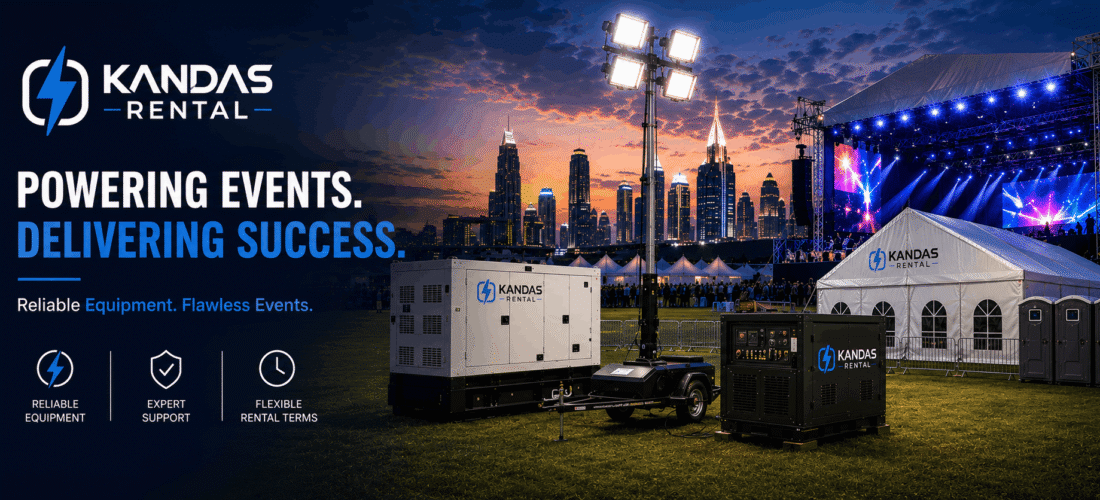
Planning an event in the UAE involves much more than choosing a venue and arranging entertainment. Reliable power, adequate lighting, electrical distribution, temporary workspaces, and supporting infrastructure can determine whether an event runs smoothly from setup to dismantling.
For corporate events, exhibitions, outdoor gatherings, festivals, sporting events, and large temporary installations, renting the right equipment provides access to the infrastructure required without the cost and responsibility of permanent ownership.
This equipment can be combined according to the event’s scale and site requirements.
The right choice depends on usage frequency, project duration, budget, maintenance requirements, and long-term equipment needs.
What Is Event Equipment Rental?
Event equipment rental is the temporary hiring of machinery, power systems, lighting equipment, and site facilities needed to support an event. Unlike purchasing, rental allows organizers to use equipment for a defined period and return it after the project. This is particularly useful when equipment is required only for event setup, the event itself, and dismantling. Depending on the project, event infrastructure may include:| Requirement | Suitable Equipment | Main Purpose |
| Temporary electricity | Generators | Powering event operations |
| Outdoor illumination | Tower lights | Lighting large areas |
| Low-noise or alternative lighting | Solar tower lights | Outdoor illumination |
| Multiple power connections | Distribution boards | Dividing electrical supply |
| Long-distance connections | Power cables | Connecting equipment and supply points |
| Multiple-generator operation | Synchronization panels | Coordinating power sources |
| Temporary administration | Office cabins | Providing on-site workspace |
| Larger temporary workspace | Office containers | Supporting event teams |
Why Is Event Equipment Important in the UAE?
Outdoor and temporary events in the UAE can present specific operational challenges. High temperatures, dust, large venues, remote locations, and limited permanent infrastructure can affect equipment planning. Organizers should therefore consider:- Outdoor temperature and environmental conditions
- Venue accessibility
- Distance between the power source and equipment
- Available electrical infrastructure
- Event operating hours
- Lighting requirements after sunset
- Equipment setup and dismantling schedules
- Backup requirements for critical systems
- Space available for generators and temporary facilities
What Equipment Do You Need for an Event?
The equipment required depends on the event rather than simply its number of attendees.For Temporary Power
Generators can provide electricity when a venue does not have sufficient permanent power capacity or when independent backup is required.For Outdoor Lighting
Lighting towers can illuminate entrances, parking areas, access routes, backstage areas, service zones, and other outdoor locations.For Electrical Distribution
Distribution boards help divide available electrical supply between different circuits and operating areas.For Multiple Power Sources
Synchronization panels can help coordinate multiple generators when a project requires more than one power source.For Temporary Offices
Office cabins and containers can provide dedicated workspaces for event managers, security teams, technical personnel, and administrative staff. This requirement-to-equipment approach is more effective than selecting equipment based only on availability.How Much Power Does an Event Need?
Power requirements should be calculated before equipment is selected. Start by preparing a list of all electrical loads, including:- Lighting systems
- Audio equipment
- Screens and displays
- Catering equipment
- Refrigeration
- Communication systems
- Temporary offices
- Security equipment
- Other electrical installations
How Do Generators Support Outdoor Events?
Generators provide an independent electricity source for locations where permanent power is unavailable or insufficient. The correct generator capacity depends on the expected electrical load and the way equipment will operate. Choosing a generator that is too small can create overload and reliability problems, while unnecessarily large equipment can increase operating costs. For larger installations, multiple generators may be considered. Synchronization equipment can support coordinated operation where multiple power sources are required. This is why generator selection should be based on an actual load assessment rather than simply choosing the largest available model.Why Are Lighting Towers Important for Events?
Lighting is essential when an event continues after sunset or takes place in an area without adequate permanent illumination. Lighting towers can be used for:- Event entrances
- Parking areas
- Access roads
- Service areas
- Backstage zones
- Outdoor activity areas
- Event setup and dismantling zones
What Is Event Power Distribution?
Generating electricity is only one part of a temporary power system. Electricity must also be delivered safely to the areas where it is required. A typical distribution setup may involve: Generator → Distribution Equipment → Power Cables → Event Equipment Distribution boards help manage multiple circuits, while appropriately selected cables connect the supply to different locations. For larger projects, power distribution should be planned according to cable lengths, load requirements, equipment positioning, access routes, and safety considerations.When Are Temporary Cabins and Office Containers Useful?
Large events often require dedicated areas for management, administration, security, technical coordination, and staff operations. Temporary office cabins and containers can provide practical workspaces without permanent construction. They can be useful for:- Event management teams
- Site administration
- Security personnel
- Technical teams
- Registration operations
- Storage and support activities
Event Equipment by Event Size
There is no single equipment package suitable for every event.1. Small Events
A smaller outdoor gathering may require limited temporary power, basic lighting, and a small number of supporting facilities.2. Medium-Sized Events
Medium events may require dedicated generators, distribution equipment, multiple lighting points, and temporary offices.3. Large Events
Large-scale events can require multiple generators, synchronization systems, extensive power distribution, numerous lighting towers, temporary workspaces, and backup arrangements. The final equipment combination should always be based on the venue assessment and actual load requirements.What Should You Consider Before Renting Event Equipment?
1. Identify the Event Requirements
Determine the event type, duration, location, expected operating hours, and equipment requirements.2. Calculate the Electrical Load
List all electrical equipment and estimate the combined operating and startup demand.3. Inspect the Venue
Assess access routes, ground conditions, available electrical infrastructure, equipment placement, and distances between supply and operating areas.4. Plan Lighting Coverage
Identify every location requiring illumination and determine whether lighting is needed during setup, the event, dismantling, or all three stages.5. Determine Backup Requirements
Critical systems may require backup power to minimize disruption if the primary supply experiences an issue.6. Confirm Logistics
Delivery, installation, collection, and equipment removal should be coordinated with the venue schedule.7. Review Equipment Specifications
Check capacity, operating requirements, dimensions, fuel requirements where applicable, and suitability for the intended environment.Renting vs Buying Event Equipment
For temporary projects, rental can offer greater flexibility than purchasing.| Renting | Buying |
| Lower initial investment | Higher upfront investment |
| Suitable for temporary requirements | Suitable for frequent long-term use |
| Equipment can be selected for each project | Equipment remains a fixed asset |
| Maintenance may be handled by the provider | Owner manages maintenance |
| No long-term equipment storage for the renter | Requires storage and asset management |
| Easy to scale for different events | Less flexible when requirements change |
How to Choose an Event Equipment Rental Company in the UAE
Choosing a rental provider is as important as choosing the equipment itself. Look for a company that offers:- A suitable range of event equipment
- Well-maintained machinery
- Clear equipment specifications
- Flexible rental periods
- Reliable delivery and collection
- Technical assistance
- Equipment recommendations
- Responsive customer support
- Experience with temporary projects
Why Choose Kandas Rental?
Kandas Rental provides event-focused equipment and temporary site solutions for projects across the UAE. Its Events range includes generators, tower lights, solar tower lights, distribution boards, power cables, synchronization panels, office containers, and office cabins. The available equipment covers several key areas of temporary event infrastructure, allowing organizers to plan power, lighting, electrical distribution, and on-site workspace requirements through a coordinated rental approach. Equipment selection can be based on the project’s specific requirements, including the intended application, duration, and site conditions.Event Equipment Rental Checklist
Before confirming an equipment rental, review the following:- Event type and size
- Venue location
- Event operating hours
- Total electrical load
- Generator capacity
- Backup power requirements
- Lighting coverage
- Distribution requirements
- Cable lengths and routing
- Temporary office requirements
- Equipment placement
- Delivery and collection schedule
- Installation requirements
- Maintenance and technical support
- Safety considerations
Conclusion
Event equipment planning should begin with the event requirements, not with a list of machines. Start by assessing the venue, calculating electrical loads, identifying lighting requirements, determining distribution needs, and deciding whether temporary workspaces are required. From there, select equipment that matches the event’s scale, duration, operating conditions, and backup requirements. A well-planned rental strategy can provide access to reliable temporary infrastructure while reducing unnecessary ownership costs and simplifying event logistics. For events across the UAE, the most effective approach is to rent the right equipment for the right application, rather than simply renting more equipment. This helps event organizers improve reliability, manage costs, and create a better operational environment from setup through completion.Frequently Asked Questions
What equipment is commonly rented for outdoor events?
Common options include generators, tower lights, solar lighting towers, distribution boards, power cables, synchronization panels, office cabins, and office containers.How do I calculate the generator size for an event?
Add the expected electrical loads of equipment that may operate simultaneously and account for startup requirements. For complex events, a professional load assessment can help determine the appropriate capacity.Are lighting towers necessary for outdoor events?
They are useful when outdoor areas need illumination after dark or when permanent lighting is insufficient. The number required depends on the size and layout of the area.Can event equipment be rented for short-term events?
Yes. rental is particularly suitable for temporary events because equipment can be hired for the required period rather than purchased as a permanent asset.What should I check before renting event equipment?
Check the equipment specifications, capacity, condition, rental period, delivery arrangements, installation requirements, support availability, and suitability for the venue.Is renting better than buying equipment for an event?
For temporary or occasional events, renting can reduce upfront investment and eliminate the need for long-term storage and ownership-related maintenance. Frequent users may find purchasing more practical depending on their long-term requirements.- August 14, 2026
- By:Febin
- Category:Uncategorized
- no comments




Post a Comment